
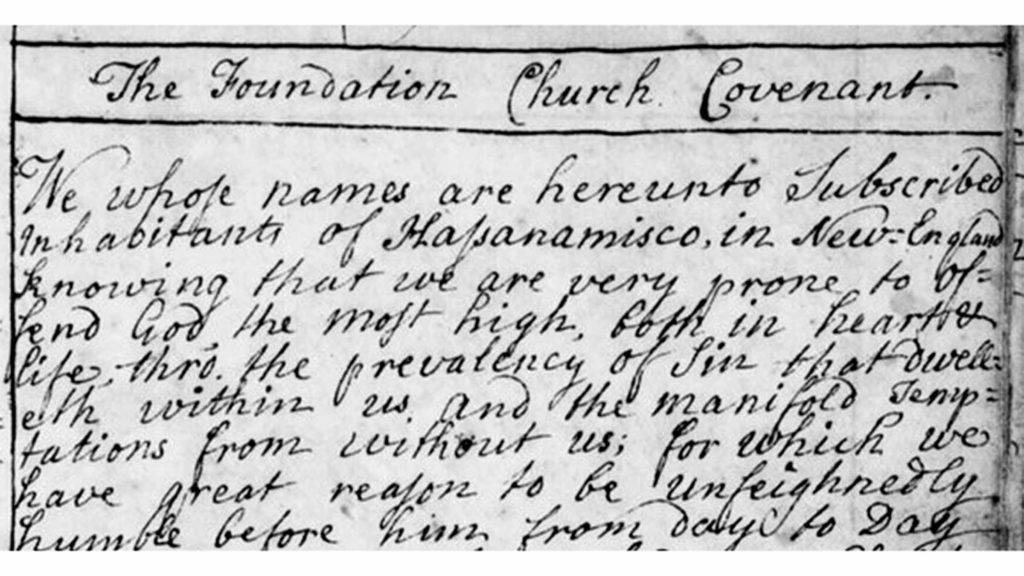
The chance of obtaining riches drew more and more Puritan settlers away from the goal of dedicating themselves to creating a godly community that rejected individual ambition. Join Lori Rogers-Stokes for an exploration of this fracture at the heart of Puritan society in New England and its disastrous consequences for the commonwealth they attempted to create. Click here for an 86-minute presentation by the Partnership for Historic Bostons.

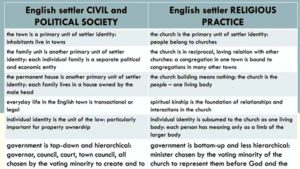
The Puritans’ great achievement was to establish the framework for a just society. They created the first coherent and remarkably fair code of law for English settlers, and built a proto-democracy that their descendants would be able to call upon and expand in the late 1700s to create the United States. Ironically, achievement of that legal society was also the core of Puritan New England’s failure: a failure to honor the letter or the spirit of their own laws, and a literal failure to practice what they preached, even among themselves. Their congregational churches represented both the pinnacle of the Puritan vision in practice in America – and the antithesis of what their society came to prize most.

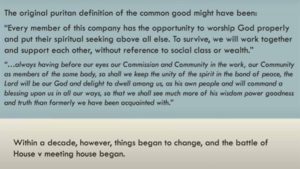
Puritan society in New England was torn apart by competition for what were perceived as infinite riches. Even as the churches worked to preserve communities based on reciprocal relationships of loving kindness, the socio-political world around them became more corrupted by land-grabbing, in-fighting, and war. Much is made of the fury that the Puritans directed against others – indigenous peoples, the Catholic French in Canada and Catholic Spanish to the south – and with good reason.

But competition for land drove New England Puritans to turn inwards, against each other, as they battled their brethren in the courts and on the ground to acquire ever more wealth. The churches could hold this in-fighting at bay for only so long before their very refusal to countenance the fight for wealth marginalized them in their own society.


d